
Banyan Roots
Banyan Roots is a podcast series in which songs and discussions from the Baul and Fakir, musical mystics of West Bengal, India and Bangladesh, guide conversations on history, ethnomusicology, and spirituality. Come curious listeners—musicians, scholars, spiritual seekers, and anyone drawn to traditional music and living devotional practices.




About the Show
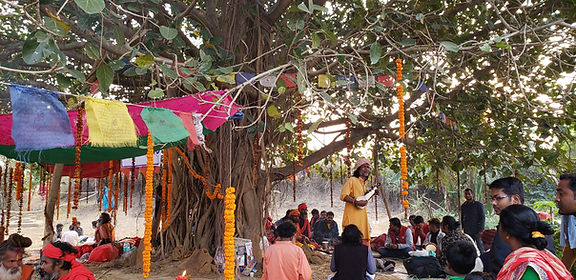
Under the interwoven canopy of criss-crossing banyan branches, teachers have sung for centuries, seeking truth of the body and the universe within their songs. Like the banyan’s dangling roots, ancient teachings have been passed down orally—ephemeral melodies and ecstatic rhythms reaching toward the earth, taking hold, and spreading into a vast network of folk traditions. One such tradition is that of the Baul and Fakir, spiritual seekers whose meditations are encoded within cryptic metaphorical songs.
Featuring original field recordings of spontaneous jams and interviews with Baul musicians and teachers, each episode explores different themes of Baul philosophy - from the awareness of the body and the breath, to the tangled roots of Bengal’s devotional traditions: Vaishnava Kirtan, Sufi Qawwali, and even traces of Vajrayana Buddhism. Listeners will be taken on an immersive journey through the remote villages of Bengal, experiencing aurally the chaotic streets, the heated debates, and the intoxicated mad music.
Banyan Roots will be presented by violinist Lucia Thomas and singer Subhajit Sengupta. The co-hosts will share their own process of learning about this music and philosophy while inviting listeners to discover more about a new culture and perhaps also about themselves.
Host Bios
Lucia Thomas is a violinist, music educator and folklorist based in Chicago, Illinois. Her musical interests include Hindustani classical, Arabic maqam, Irish and Appalachian folk, and various genres of Latin American and Balkan music. Her quest for traditional tunes led her on a year-long bicycle journey across the Balkans in 2013. In 2016, Lucia met her to-be husband Subhajit Sengupta, from West Bengal, India, who began teaching her compositions by Rabindranath Tagore and also songs of the Baul and Fakir. Following a longing to learn more about Baul philosophy and music, she applied to the Fulbright-Nehru program. She was very fortunate to become a two-time Fulbright awardee which she used to record music and interviews with Bauls and Fakirs throughout the villages of West Bengal, India.
Lucia and Subho's most recent album "Praner Alap–Meeting of Hearts" is a collection of Rabindranath Tagore's music and poetry with Lucia’s own English translations of the lyrics in an accompanying artbook. In 2019, Lucia released an album of dance music from around the world with an all-female band called "Baba Yaga's Stew." In 2016, she co-authored “The World in Chicago,” an album/book pairing of music and oral histories from Argentina, Thailand, Ghana, Jordan, and Serbia recorded by the group Chicago Folklore Ensemble.
Lucia is now pursuing a solo career as a Hindustani violinist, under the guidance of her guru, maestro Indradeep Ghosh. She is the string conductor of Ravinia Festival's El Sistema Middle School Orchestra. Driven by a strong commitment to human connection, Lucia bridges cultural divides with music, building on its age-old tradition of honoring human commonalities, challenging injustice, and celebrating everyday beauty.
Subhajit Sengupta (Subho) is a Chicago-based Bengali-American vocalist, composer, community artist, and co-founder/artistic director of Ochin Pakhi, a Rogers Park–based ensemble dedicated to cultural exchange through music. Raised in Bhadreswar near Kolkata, India, he grew up immersed in Bengali musical traditions and received formal training in Rabindra Sangeet and Hindustani classical vocal music, alongside studies in folk, Nazrulgeeti, Baul-Fakir, Bhajan, and Ghazal forms.
Tagore’s songs and philosophy form a central foundation of Subhajit’s artistic journey, shaping his understanding of music as a space for humanism, introspection, and social connection. His work also engages deeply with the mystical traditions of Bengal’s Bauls and Fakirs—especially the songs of Lalon Fakir—approached as living, questioning practices. Through performance, composition, and community collaboration, he creates inclusive spaces where music becomes a bridge across cultures, neighborhoods, and belief systems.

1
Songs of the Unknown Bird
Songs of the Unknown Bird introduces listeners to the Baul and Fakir—musical mystics from Bengal who seek an internal God through their songs and meditations. In this episode of Banyan Roots, hosts Lucia Thomas and Subhajit Sengupta explore Deho Twotto, the Baul idea that the body itself is the starting point for spiritual understanding.Through original field recordings Lucia took in villages and towns across West Bengal, the episode features powerful songs and reflections by Baul masters, alongside explanations of their imagery and language.
A recurring metaphor within many of the songs is ochin pakhi meaning “unknown bird,” a poetic image for the breath. Listeners learn how Baul songs use coded language within their lyrics—speaking of the unknown bird, news of the wind, and a cage with eight chambers and nine doors—to describe various meditations and one’s inner awareness.Blending personal narrative, philosophy, and music, this episode reflects on living a good life, the importance of a guru or teacher, and the challenges facing the Baul community today—inviting listeners to listen deeply, inwardly, and with abandon.
Painting credit: Dipshikha Debnath


2
Searching for the Man of the Heart
Searching for the Man of the Heart explores how Baul songs use the metaphor of the house to describe the human body, which, for the Baul, is the starting place for realization. In this episode of Banyan Roots, listeners hear lyrics with cryptic images that point toward what the Baul call the praner manus “the man of the heart”–a personification of one’s inner truth.
With translated songs by poet-saints such as Lalon Fakir and interviews with contemporary Baul singers and teachers, the episode reveals how ideas like breath awareness, the role of the guru, and the freedom of nothingness have been preserved in song lyrics rather than written texts. Listeners are introduced to the historical roots of these metaphors, tracing connections between Baul philosophy and ancient Buddhist practices within a 1000-year old Buddhist text called Charyapada.
Blending beautiful field recordings, historical anecdotes and interviews with Baul masters, this episode gives deeper insight into the ancient origins of the Baul practice and invites listeners to reflect on the relevance of these lyrics even today.


3
Lalon’s Liberation: Worshiping in the Temple of the Mind
The Baul songs in this third episode challenge divisive religious identities and beg for a society where all humans treat each other well. It will share some background on the painful history of the partition of India as well as dive deeper into the life story of Lalon Fakir, the legendary Baul saint from the late 18th century.


4
Rejecting Caste: All are Brothers of my Heart
“Rejecting Caste – All are Brothers of my Heart" is a further exploration of manus twatto - the theory of humanity, this time focused on jat, or caste. Some Fakiri singers will discuss what caste felt like to them and what the great poet-saint Lalon Fakir had to say about caste.


5
In the Garden of Krishna’s Love
In the Garden of Krishna’s Love is the first episode to explore bhakti - devotion, and specifically songs showing devotion to Hindu Gods and Goddesses. We will hear from Baul masters on the importance of devotion in one’s spiritual progress as well as learn the historical significance of the Bhakti movement in India.


Questions?
Get in touch with us!